2012-03-01

I've upgraded to the best camera in the world

It's been almost 2 years since I posted on this blog. A lot has happened in these 2 years. In 2009 I picked up photography again. I picked up a bunch of nice professional grade equipments. I started collecting vintage cameras. I quit my day job to do my own startup for 6 months and it failed. I co-founded yet another startup. I moved from a sleepy suburb closer to tech companies and clients. My son was born. My startup was acquired. I moved even closer to tech companies. I finally upgraded to the world's best camera.

They say that having a child changes your life. Having Calvin really changed the way I do photography. Two years ago, I had professional lenses and photographic equipments. I carried 10-15 pounds of equipments on my body everywhere I went. Today, my family is upgraded, and likewise I finally upgraded to the world's best camera. You may be wondering what it is. The world's best camera is the one that you have on your hand. That's it. Here they are, my beloved Canon S90 and iPhone4:

"WHATTTT???" you may be wondering. Well, when you have a 20+ pound kid you need to carry who constantly needs attention, food, diaper change, you basically have no need for a camera. In addition, you're already carrying an extra 5-10 pounds of support system that includes water, bottle, formula, towels, baby seat, baby seat stroller, umbrella stroller, toys toys toys, diapers diapers diapers. When you have so much stuff to carry and you're going from one taxi to another taxi, taking escalators, going from one street to another street, you simply don't have more room [and energy] to carry unnecessary things like bulky professional grade SLR equipments + professional grade (read: 5 pound) lenses + flash + umbrella + bouncer.

With a kid there is very little time for unnecessary hobbies like photo editing, photography, and blogging. These couple of weeks I finally allocated time to sell stuff I don't need anymore: Canon XSI, Canon 18-55mm, Canon 55-250mm, Canon MP-E 65mm, Canon 10-24mm, Nikkor 14-24mm, Nikkor 85mm f/1.4D, Lensbaby Composer, Leica M3 SS and 50mm Summicron, Leica M6 and Voigtlander 45mm. Typically, you lose a lot of money when you sell used equipments. In the case of photography, if you're smart about purchasing (buy from desperate CL sellers, or auto-buy on eBay on Wednesday at 3AM) and selling (sell on Sat/Sun night), then you can actually make money!
  • Canon XSI + 18-55 and 55-250mm. Bought new (B&H) for $750. Sold for $450. -$300.
  • Canon 10-24mm. Bought used (eBay) for $550. Gave it away as a gift.
  • Lensbaby Composer. Bought used (eBay) for $230. Sold for $140. -$90.
  • Canon MP-E 65mm. Bought almost new (Craigslist) for $600. Sold for $850. +$250.
  • Nikkor 14-24mm. Bought almost new (eBay) for $1500. Sold for $1600. +$100.
  • Nikkor 85mm f/1.4D. Bought used (eBay) for $850. Sold for $900. +$50.
  • Leica M3 + Summicron. Bought used (eBay) for $850. Sold for $1300. +$450.
  • Leica M6 + Voigtlangder 45mm. Bought used (Craigslist) for $1100. Sold for $1600. +$500.
They say that professional glass (lenses) hold values and that the value of bodies drop like a rock. Well, my data-points illustrates this. For example the Canon XSI is a plasticy consumer grade equipment, and like all computers, it doesn't hold up values very well. One of the reasons is that the body is basically a computer where a new model comes out every few years. Now, in the case of my Canon 10-24mm, I could have resold it on eBay for $600, but I decided that it's a pretty good gift (and the recipient can still convert it to cash for $600 on eBay). Another big loss is the Lensbaby Composer. It is just a plastic toy lens that is over-hyped via marketing where new models come out every once in a while. All the other lenses (Nikkor and MP-E 65mm) I mentioned are professional grade thus they've held up their values very well. In the case of the Leicas, well, I actually bought them beat up, fixed them up, and resold them back on the market at a much much higher price. If done right, this is a hobby that you can actually make a little bit of money!

So, that's it. Having a child changes everything. The best camera is the one that you have on your hand. Happy shooting!

2010-05-15

Mao Post for Ping

It's been a while since I posted anything. I've been spending most of my time in the startup and therefore haven't done much personal photography latelyl. I shot these long long long time ago for my friend Ping and forgot to post on the blog. To my surprise many people (including Ping) likes the following picture the most:


These are what I informally called the "Mao Style" picture. Why? Because of this genre that we're familiar with (happy people looking up with hope). In fact you can probably stick this style into any government propaganda and it'll just look as fitting:


FYI some of the original shots are here

2010-02-04

Autofocus without mechanical movements?

Focusing a lens requires moving the lens back and forth. That's the way it has been for over 100 years. This is even true with Nikon's SWM (silent wave motor) and Canon's USM (ultrasonic motor), where the mechanism for moving the lens back-and-forth is quiet.

Today I just stumbled on the following news that a company raised $30 million dollars to create cameras that can autofocus without mechanical movements! You apply voltage to a lens that changes the refractive index. WHOA!!!!!! I've heard lenses that can change opacity by applying voltage, but changing refractive index is a first for me. Imagine, if this is possible on a teeny-weeny scaled lens, who knows what the future of big lens technology will be like in another 100 years? In the 22nd century, we'll probably look back to 2010 and laugh at the $8000.00 super 600mm f/2.8L/G FX SWM/USM auto focus lens that weighs 999 tons.

2010-02-01

Hyperfocal Distance > $5500 camera

What's the solution to taking consistently sharp pictures in extremely challenging conditions, such as a bunch of people dancing in extreme darkness? You know that a $100 point and shoot just won't do the job because the high ISO setting on cheap $100 camera is way too noisy, and the auto focus on a little camera is horrible. Even a $500 SLR camera won't do justice. Heck, a $1000 SLR used improperly won't do it either. On the other hand, a top of the line $5500 camera body with 1000000 computerized AI auto focus and expensive high quality $1000 prime lens and extreme high ISO would work reasonably well. This is a viable solution. It's also a very expensive one too.

You don't really need a $5000 body and a $1000 camera lens. You just need to understand the limitations of your camera equipments. First of all, you don't need a zillion computerized AI auto focus like the ones on Nikon D3s ($5500) or Canon 1Ds mark IV ($5800). You don't need auto focus, period! People in the really manual film days took perfectly good pictures without auto focus. Their secrets? 1) super wide angle lens and 2) knowing what "hyperfocal distance" is.

There are many complex definitions to hyperfocal distance. Here is my simplified, Cliffs Notes version: by turning focus distance to a pre-known constant "hyperfocal distance" and constant aperture, all objects between a known distance to infinity will be in focus. For example, I know that on my APS-C SLR fitted with a 10mm lens, setting the distance to 3 feet (its hyperfocal distance) at f/5.6 means that all objects between 2 feet and infinity will be in focus, period. Combine this with TTL flash, then I simply make sure there is at least 2 feet between the camera and things in front of it, and shoot away. I don't even have to think, I just shoot away. It's that easy. Basically, I'm relying on the fact that 1) wide angle lenses have much deeper depth of field and 2) knowing what my hyperfocal distance and minimum focus distance is.

You can find out what your hyperfocal distance is by experimentation, by looking at tick marks on your lens, or by manually calculating it. It's more accurate to calculate it, so here are some links about this topic:
http://www.dofmaster.com/hyperfocal.html (what is hyperfocal distance)
http://www.dofmaster.com/equations.html (calculating hyperfocal distance)
http://www.dofmaster.com/dofjs.html (calculator that gives you hyperfocal and min distance)

Knowing about hyperfocal distance, everyone can take consistently sharp night pictures of moving objects using low end SLRs, TTL flash, and high quality wide angle lenses for a fraction of the cost. Sorry Canon/Nikon, I'm not buying your $5000+ camera with the latest and greatest computer + electronics gadgetry. Technology is overrated. Knowledge is cheaper.

2010-01-16

Annie and David's Wedding

Seriously behind on processing photos... CONGRATS :) Here is a preview. The whole set will be ready soon. You can click on the images to get a bigger resolution (to get full resolution, email me). The first one is HUGE.

2010-01-11

Wedding costs


Not related to photography but I thought this was kind of interesting: http://bridepop.com/everything-else/weddings-by-the-numbers-infograph/

Basically, if you want to have a cheap wedding, go to Las Vegas or Los Angeles. I guess it kind of sucks to be a wedding vendor in these areas because of low cost margins. If on the other hand you're a wedding vendor, San Francisco or San Jose may be a cash cow! In fact, people in Northern Cal pay nearly TWICE as much for their weddings as people in Southern Cal. What's up with that? Is it because of all these spoiled rich dot-comers that have too much money to waste? Or is it the fact that there are simply too many wannabe photographers in the Los Angeles area who aspire to shoot movie stars and such? I don't know. I can only guess from the numbers. Anyways, of the total cost of weddings, about 23% of the entire budget is allocated for photography/videography. Whoa!!! That's a whopping $3691 spent on video/photos per wedding! Wow.

2010-01-07

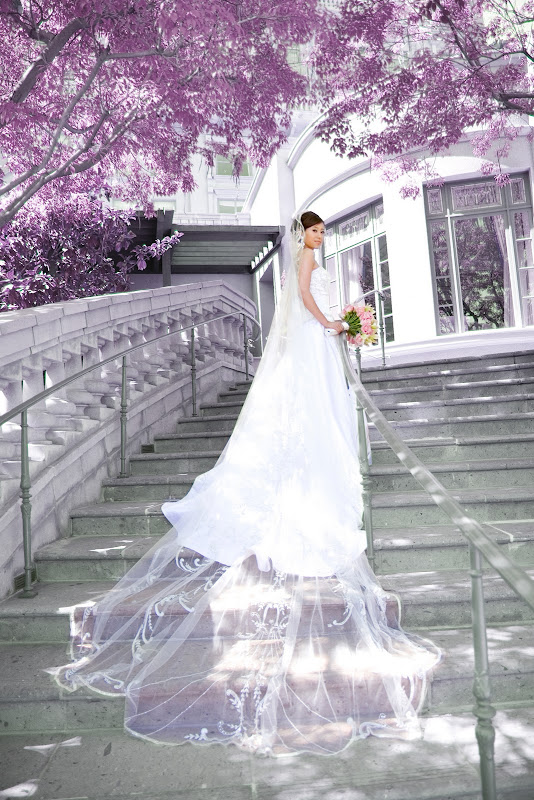
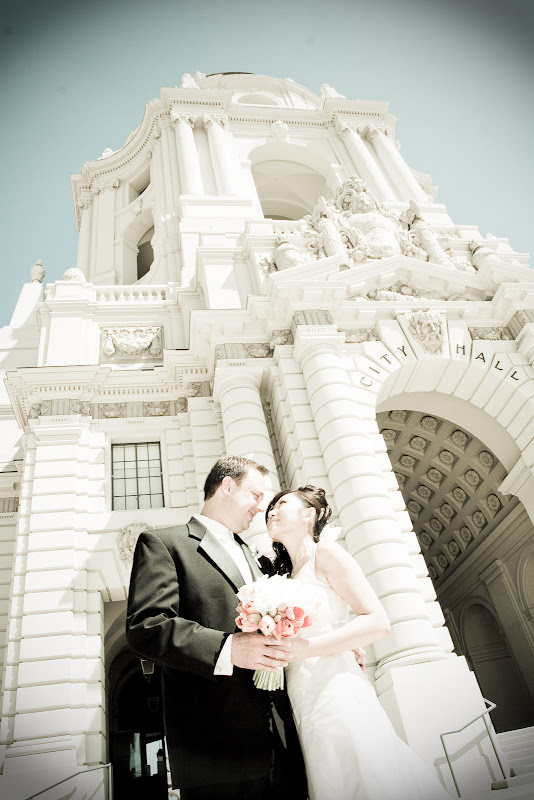
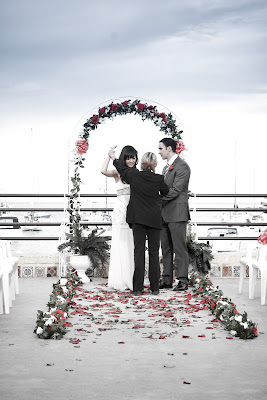
2010 Asian Engagement Shoot aka 婚纱藝術攝影

I got tons of engagement shoot pictures from projects that Ivan and I have been working on. What do I do with these pictures? I style them. There are many ways to style pictures. For example, many westernized clients prefer the photojournalistic style. That is, they like it raw, unscripted, unedited, in the moment, and usually in black and white. Western style is no styling, very little post processing (我不是在開玩笑). However in Asian cultures (especially in Taiwan, China, Hong Kong, Singapore, etc), most clients prefer the surreal look. This is why Asian weddings always split up the photo sessions into two separate days-- 1) the engagement shoot aka 婚纱摄影 usually shot at least a month in advance, with professional makeup, hair styling, and 3-5 dress styles (纱, 裝/旗袍, 禮服) shot in a professional studio for an entire day and 2) regular on-the-day wedding shots. Look, you can't go to Taiwan or China and not do 婚纱摄影, because many Asian photographers consider the on-the-day pictures to be random, uncontrollable, sloppy work. 他們說老美拍照馬虎的 :) Personally, 覺得老美太貴了!!! LOL哈哈哈 !!! 例如一本書他們要收3倍,說很好聽,但是印刷仍然在陸!
Because LA clients in San Gabriel are almost all Asian, I toned these in the popular style that appeals to Asian customers. Color. Contrast. Surreal. Ultimately, art is subjective. The photojournalistic purists may call the Asian style "cheezy" or "trying too hard." But if this is the style that paying clients want, then that is the style that speaks to them! So call this style whatever you want to call it. If you're not buying, then one cares what you think :)


I got a bunch more pictures on my hard drive, but I'm too busy to process them at the moment. I'll probably see you guys next month. So stay tuned!

2010-01-01

Happy New Year

Happy New Year! This is the first post of 2010. It was a lot of fun.


2009-12-27

Catching up: November and December

I have a huge backlog of things that I haven't had a chance to post here. Highlights: I had a chance to meet up with my buddies from junior high who came all the way down to the LA area and that's pretty cool.

I met up with Richard on the Thanksgiving break. I actually ate MEAT!!! Ribs, at Richard's place. I know this sounds weird, but it was such an amazing experience. Just a few week before I was still eating porridge and soft food. I've been sick pretty from severe ulcer almost 1/2 of the year and been on one medication after another and couldn't even eat regular food, like burgers, pizza, boba tea, etc. I've lost almost 10 pounds this year, and I was already a chopstick before I got ill. Well, late November I started getting better... and at Richard's place I ate ribs!!!!!!!! It's amazing how little things can make you happy. Anyways, they say a picture is worth a thousand words so without boring you, here are some pics:


I met up with Eric during the Christmas break. Baby Evan was only a few months old! It was so great sitting down with everyone, eat food that normal people eat, and chit chat and catch up. That means... I didn't really take as many pictures, but it's alright. Sometimes I prefer to relax and be a civilian than to be a photographer.

2009-12-24

Humor: pet photography

From http://graphjam.com/2009/12/22/funny-graphs-pet-photography/

2009-11-11

Color IQ: Color test your eyes

A lot of people ask me how to do color balancing. How much of it is subjective/objective? What's the best approach? Is there a system to it, or is it all about art?

This is a complex subject that I have an easy, fast, and systematic way of dealing with it. A professional photographer doesn't need to have a perfect sense of what white color should be. He/she simply needs to balance the color such that there is a good separation of non-white colors and white colors. In today's world, color balancing is done in several ways. One camp of school is to do it in-camera and shoot JPG and set the WB setting perfectly the first time. This leaves no room for error because a wrong color balance setting on the camera can mean un-recoverable color tones. The other camp of school is to shoot in RAW and post-process the RAW. Post processing is easy. If a picture has bits of perfect white/gray color, he/she can tell the program what that white/gray tone is, and thus set the entire picture into perfect tones. However, not all white and gray-looking surfaces are of balanced colors. Most likely, all surfaces have a hint of blue/yellow, or variation with hue in them. In addition, certain lighting conditions simply do not produce a balanced lighting (CFL, sodium light), in which case it's best to turn the photograph into black and white.

In many cases, one needs to use his/her eyes to make the final judgement. This requires 1) having good sets of eyes and 2) color balanced monitors (most Macs are pretty good). Without good eyes, a perfect monitor is useless. Likewise, the reverse is true.

To date, I only found one good site that tests your eye's ability to distinguish color. It is XRite http://www.xrite.com/custom_page.aspx?PageID=77

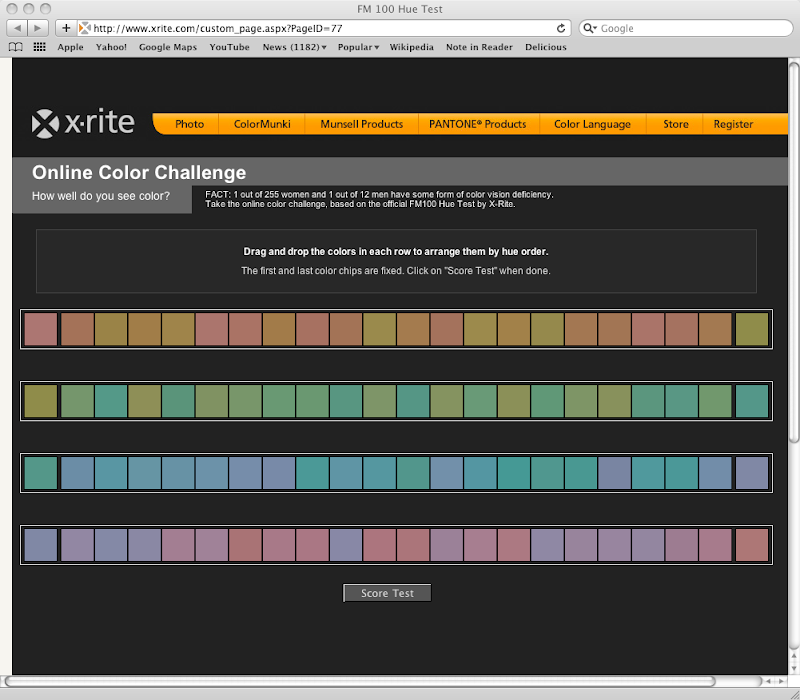
Give it a try! It's pretty fun. This is what you see when you start:

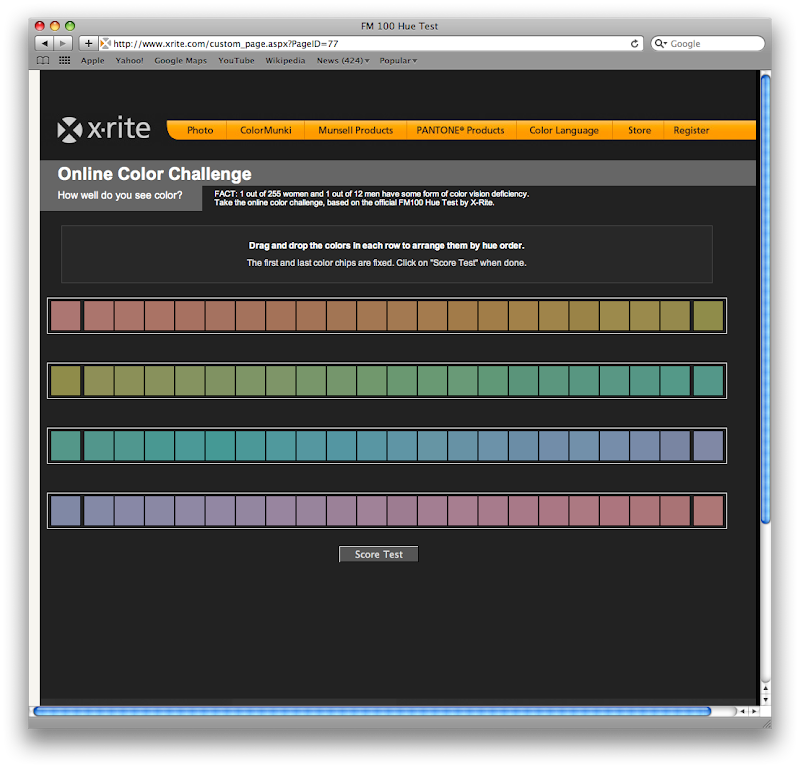
This is what you want to end up with when you're done:

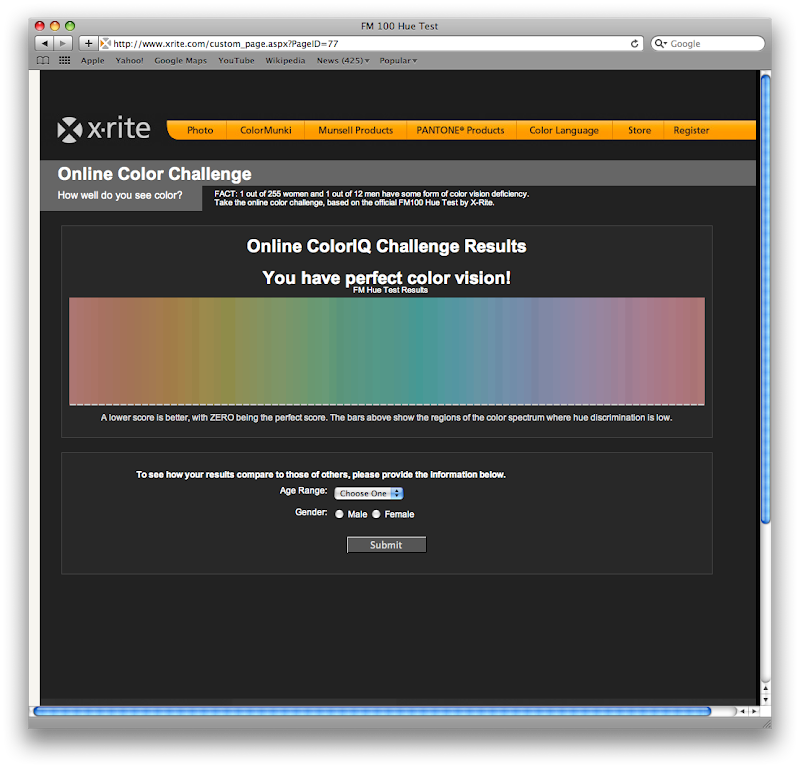
You get a score at the end.
Have fun!

Now about the subjective part. One can always tone a picture to look a certain way. After color balancing, it is easy to add a bit more yellow (to look more vintage, to give more warmth at night, etc), or a little bit of blue (to give a little bit of that cold look). What I do personally is to always color balance first, THEN tone the picture. Reverse the order and you'll get into a lot of weird results and inconsistency. In summary, do the followings in this order:

1) Get good monitors, and calibrate it using tools like Spyder 3, etc.
2) Verify that you have a decent sense of color by going to the XRite site
3) White balance your pictures
4) Tone if necessary

2009-10-11

Canon vs. Nikon Marketing Strategies

I meant to post this last year but somehow didn't get a chance to finish writing it, thus please back-date this blog to 2008.

Canon and Nikon have been fighting in the SLR and DSLR market for several decades. From the 60s to mid 80s, Nikon dominated the professional film SLR market share. When Canon came out with better technologies such as auto focus and other electronics automation after the mid 80s, many pros (especially those who shoot sports) switched to the Canon EF-mount system. For the next few decades, Canon SLR (and lately DSLR) dominated both the pro and consumer SLR market. Today the competition is just starting to heat up. Every few months, both companies come out with something better and/or lower priced than the other brand. Both companies get a bulk of their revenue *not* from their professional grade camera equipment, but with a flood of plastic, cheaply made consumer grade equipments (sub $500, sub $750, and sub $1000 SLR cameras and cheap kit lenses).

The consumer grade segment of the market is most vital to both companies because they account for a bulk of their revenue and thus is their bread and butter. One way to gauge the competition is to go to a store. I go to Costco frequently and chuckle whenever I see both Canon and Nikon DSLR boxes side by side. As of late 2008, the two consumer grade cameras that Costco sells are the Canon XSi and D60. While both try to compete for similar price range, looking at the boxes, one may feel that they're actually aiming for different types of consumers!

Below is a 2008 Canon XSi picture I took using a Canon SD740 point-and-shoot camera at Costco. The box shows a frozen action of a boy catching a football. Guys love sports. Guys love frozen action, and zoom. There's something about BIG ZOOM, having a big zoom is like having a nice sportscar with XXX horsepower and YYY torque. Guys want the biggest plasma/LCD TV. Fastest cars. Most megahertz computers. Things of that sort. This Canon Rebel is a guy's camera. Just look at the specs, it's sexy!


Below is the exact same item as above but has a different packaging, in 2009. Look at the fancy jargons like "Optical Image Stabilizer Double Zoom Lens Kit", and below, a bunch of fancy stuff like "12.2 MEGAPIXELS", "Digic III", "3 inch LCD", "3.5 Frames per second", "EOS", "Picture Style". Wow! If I were a guy who loves to look at specifications all day, I'd get a Canon Rebel because it's obviously better on a spec-by-spec comparisons.


Let's now look at the Nikon D60. You see a woman with a bunch of smaller images on the side (baby smiling, flower, kids, etc). There's no sports. There's no emphasis on frozen action. There is no fancy jargons to woe you. There IS however lots of emphasis on people... portraits... softness... prettiness... connection to people. No jargon, just "FAST, FUN, & EASY." Nikon's strategy is about connecting to people in the simplest possible way.


Let's look at another Nikon, the D5000 (2009). Unlike Canon that screams technical jargons and specifications, Nikon box simply says "Smart, Sharp, Simply Brilliant." Again the emphasis is on people. Happy people, with happy emotions.


Let's look at yet another Nikon, the D3000. Similarly, it's got happy people. Kids. The camera captured the moment. "Incredible pictures, incredibly easy."


So what's going on? Canon's strategy is to use what they're traditionally good at: sports and specs. Do you remember the late 1980s when Canon EOS Rebel flooded TV with their ads blitz? "It's so easy to use, amateurs can capture Andre Agassi like a pro!" Canon loves to show pictures of sports, frozen in time. In addition, Canon uses higher specifications (higher megapixel, more frames per second, higher processor name, etc) to lure certain types of buyers-- the Specification Peepers. Boys. Men. Guys. People who generally want the highest megapixels, biggest LCDs, most horsepower, most torque, biggest lens, biggest of everything. Canon is the ultimate boy's toy, because boys can brag to each other that they have a biggest spec'ed camera, the Canon. You know,"my cannon/piano/whatever is at least 3 inches longer and thicker than yours so I'm a more dominant male", that sort of thing. Spec for spec, Canon will have more features, for the same price or lower. Canon [on paper] is the most incredible machine on earth. Not surprisingly, Canon is an engineering company where engineers design and optimize the camera by spec, and they will out-spec any competitor, period.

What does that leave Nikon with? Nikon's strategy isn't to use specification to sell.
Nikon doesn't need to compete on specs, because not all specs are relevant to the discerned buyer. For example, higher megapixels doesn't mean better image quality (in fact, more megapixel means more noise at night). There are other things to consider, like contrast and color rendition that Nikon excels at. For example (on similar settings), Nikon tends have warmer and more accurate auto white balancing hence psychologically more eye pleasing portraitures (this is all according to DXO Mark). In addition, Nikon tends to have lower megapixels but better night time capability (higher ISO with lower noise), whereas Canon tends to have higher megapixels (great during day time) but less night time capability (higher ISO with higher noise). Of course, color/contrast/night pictures are difficult to sell so instead of trying to describe it as specs, Nikon marketing decides to simply put portraiture of people on their boxes hoping people could just see how great their cameras are. There are other intangible items that Nikon hopes discerned users can feel such as better built quality (vs. the cheaper plastic housing of Rebels); Nikon is traditionally known to be more rugged and this has been true since the 60s when more journalist used Nikons to take pictures of Korean and Vietnam war than any other brands, and that more Nikons went to space & NASA than any other brand. They are also known to have excellent usability, and usability consistency in their product lines (a consumer D40's UI isn't too different than that of the professional D700).

None of the differences should be a surprise. The two camera brands have had very different philosophies since the 50s and 60s. Canon embraces the latest and greatest technologies while mass producing them (at the cost of durability) whereas Nikon is conservative and will only embrace new technology when absolutely necessary. Also, they have had very different philosophies in what types of images their cameras should capture. In the old days for example, Canon traditionally values more resolution (at mid-aperture), whereas Nikon values more contrast at wide-open. Below is an illustration of a 1950's pictures (directly from
Dante Stella's article on resolution vs. contrast trade-offs in lens design, http://www.dantestella.com/technical/nikoleic.html):


On the left is Canon, which gives great resolution at mid-aperture. On the other hand, to the right is Nikon which gives great contrast wide-open. There is no "wrong" choice in trade-offs, just preferences. Photographers shooting sports or landscape is likely to opt for the company that values great resolution (higher MTF 30 lp/mm and higher megapixels on the Canon), and photographers shooting portraits and/or at night is likely to opt for the company that values contrast (higher MTF 10 lp/mm and better ISO on the Nikon).

Today, the differences in contrast and resolution between the two companies is no longer a big factors in choosing the "right brands". Both companies employ engineering techniques to yield some of the best products that we have seen to date, and both companies make lenses that yield very similar resolution and contrasts. Today, what makes them different is that Canon is consistently making higher megapixel cameras (21MP) that looks amazing during day time and decent at night, whereas Nikon is consistently making lower megapixel cameras (12.1MPP) that looks decent during day but superb at night. Like the old days, Canon still uses more plastic parts today to save costs and pass the savings to consumers (e.g. 5Dmk2, T1i) whereas Nikon has slightly better built quality to endure harsher conditions better (e.g. D700, D90) but cost more.

In short both companies embrace very different philosophies and employ different engineering techniques and both create great products. Sometimes there is no right camera to use for every single possible situation. For certain situations, Canon can be marginally better than Nikon, and vice versa. I for one prefer Canon and its superior pro-telephoto lens selections for events such as sports/bird shooting, but at other times I prefer Nikon for their Creative Lighting System for shooting portraitures, product shots, and night time.


-----------------------------------------
Links to other sites:
Trade-offs in lens engineering:
http://www.luminous-landscape.com/tutorials/understanding-series/understanding-mtf.shtml

Contrast vs. resolution philosophies of Leica, Contax, Canon, and Nikon:
http://www.photoethnography.com/ClassicCameras/index-frameset.html?focusing.html~mainFrame