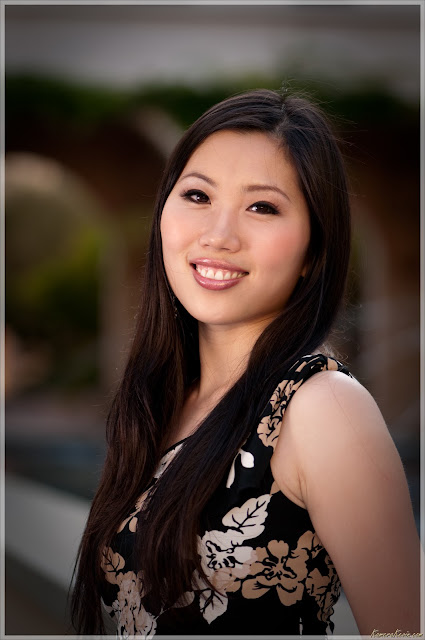
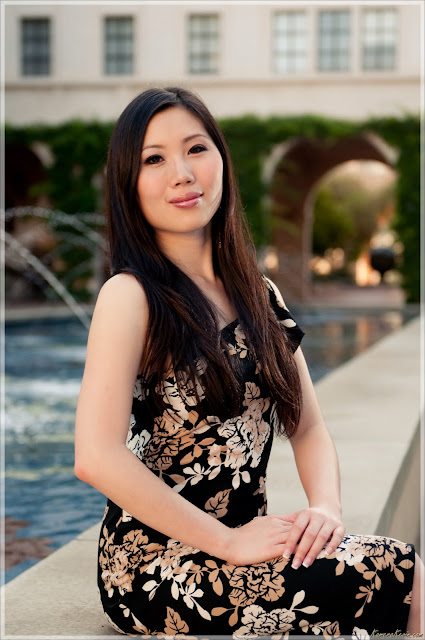
I was curious one day and went to the women's hair coloring section in Walgreens and snapped a few pictures with my wife's Canon SD750 (it is such an amazing camera!):

No, I didn't walk in with an SLR. I find that the moment I put my eyes through a camera's view-finder, I get kicked out 90% of the time whenever I'm on a private property for one reason or another. SLRs are huge, cumbersome, and impractical to use most of the time.
I organized the snapshots below. Take a careful look at them. Photographically speaking, what do these pictures have in common? Which pictures do you like/dislike and/or catch your eyes? Try to answer these questions as you're looking through these pictures:

Photographically speaking, these pictures have the followings in common:
1) All of them used diffusers (bounce, softbox, octobox, or umbrella) to cast gentle lighting on the face, to either carve and accentuate some parts of the face, or to flatten the shape of some parts the face.
2) All the eyes are in sharp focus. They say the eye is the window to a person's soul, and when the eyes are in focus, the entire picture is in focus [psychologically speaking].
3) Almost all have at least 1 main catch light in the eyes, placed between 1 o'clock and 11 o'clock position-- aka your very standard text book studio shot. Wikipedia says "Catchlight is a photography term used to describe either the specular highlight in a subject's eye from a light source, or the light source itself. They are also referred to as eye lights or Obies, the latter a reference to Merle Oberon, who was frequently lit using this technique. A catch light may be an artifact of the lighting method, or have been purposely engineered to add a glint or "spark" to a subject's eye during photography. This technique is useful in both still and motion picture photography. Adding a catch light can help draw attention to the subject's eyes, which may otherwise get lost among other elements in the scene."
4) All the catch light are using interior artificial lighting, be it an umbrella, softbox, octobox, or some type of studio diffuser. Four models on the left column used a single softbox (square). A softbox looks like the following:

In fact, if you look at the eyes carefully where there is a white bright square in their eyes, you'll also see a little bit of a ball shaped thing below the white square. That is actually a photographer's head! This is pretty common in studio settings where you want the softbox slightly on top of the model, and the photographer needs to get in front of the softbox to make the shot.
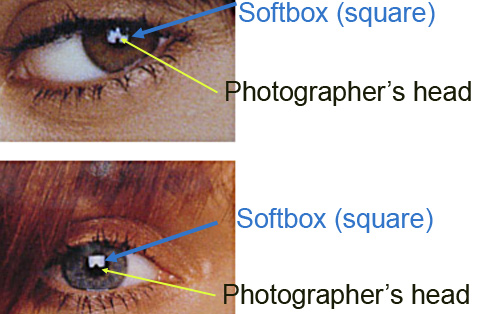
The rest of the pictures use either octobox or umbrellas. An octobox looks like the followings:


Portable studio umbrellas look like the following (there's also a bounce panel to the right):

When a human being looks at a portrait, he/she has an intuition what looks good or not. But photographers can go one step further and decompose and analyze at how the portrait is shot. In the case of portraits, pictures that have catch light have a higher tendency to catches the viewers' attention.
There is one picture that does not place the main catch light between the 1 o'clock and 11 o'clock position. That's the bottom right model where the catch light is actually below and to the right of the model's pupil. This gives her a little bit of a mysterious look (along with a darker broad lighting position to cast more shadows on her left cheek, to make her look even more mysterious than the other models).
Going back to the model pictures, which models catch your eyes? What lighting techniques are used in those pictures that you like? Do you prefer a single source catch light, or multiple light source catch light? Do you prefer the look of a softbox (looks more like a window), or do you prefect the octobox/umbrella look?
* Men's hair dye products do not emphasize the eye as much. The catch light is typically smaller because the photographer usually moves the lighting a bit farther. Farther lighting source gives a bit more harsh feel to the face (opposite of diffusing light for women), which is appropriate if you want the man to look harsher and more manly. Go to any men's hair color section and you'll see what I mean-- smaller catch light, harsher lighting source that yields more square looking face.